French Open Men’s Draw Blown Open After Jannik Sinner’s Shock Defeat to Juan Manuel Cerundolo
The men’s draw at the French Open has been completely altered following one of the biggest shocks at Roland Garros 2026. Top seed and world number 1 Jannik Sinner’s second-round loss to Argentina’s Juan Manuel Cerundolo has immediately changed the shape of this tournament.
Prior to the match, most tennis experts believed Sinner would cruise through the first rounds of the French Open. Carlos Alcaraz had already pulled out of the competition due to a wrist injury. In addition, Sinner was coming into Paris having won 30 consecutive matches, looking like a player very difficult to defeat in the competition for the Coupe des Mousquetaires.
Then a complete change occurred.
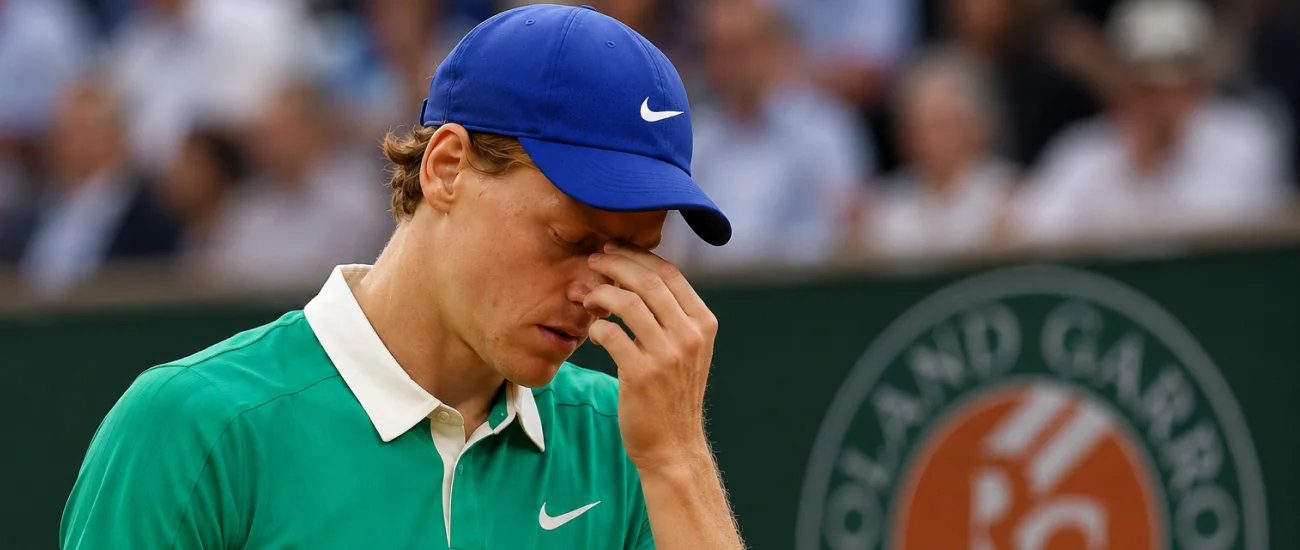
Sinner started the match very well, winning the first two sets with apparent ease. As the match progressed in the heat of Paris, Sinner began to lose energy. Cerundolo maintained composure, kept the ball in play, and gradually converted the match into one of the greatest shocks at the tournament. By the end, Sinner’s French Open defeat was the biggest story of the day.
The French Open Title Race is Wide-Open After the Absences of Sinner and Alcaraz
There are many players that now have the chance to win the French Open: Novak Djokovic, Alexander Zverev, Casper Ruud, Rafael Jodar, Moise Kouame, et al. Most of them will find their route to the final a bit easier. However, open draws can be both good and bad. With opportunity comes pressure, and the French Open has historically shown no mercy to players who start looking beyond their next match.
Sinner Loses to Cerundolo in Upsetting Fashion
The headline says it all: Sinner Lost to Juan Manuel Cerundolo in Round Two of the French Open.
For two and a half sets, the thought of that result was utterly unimaginable. Sinner was playing the game with great confidence, controlling the match from the baseline and forcing Cerundolo to defend. At that point in the match, Sinner’s timing and footwork looked perfect, and he was making clever shot selections, meaning his way to an easy victory was already pretty well on track.
However, tennis is played in the present, and matches can change quickly, particularly when conditions are hard. As this match progressed, Sinner appeared to be losing his comfort level. His foot speed seemed to slow down. His body language changed. The bullets he had so easily hit earlier in his winning streak began to disappear.
Cerundolo’s performance is commendable because he remained calm under pressure, avoided risky shots, and employed a strategy of extending rallies and forcing Sinner to keep working hard throughout the match. This strategy became increasingly successful as Sinner began to show fatigue.
Cerundolo’s success in coming back from 2 sets down to win a 5-set match is one of the rarest comebacks in tennis and was not something anyone inside Court Philippe Chatrier would have predicted in the final stages of the match.
Cerundolo’s victory will be recognised not only as an upset but also as a significant event in the tournament’s overall results.
Why The Sinner Defeat Changes Men’s Singles Draw At French Open
Sinner’s early exit from the 2026 French Open will have an impact on the remainder of the tournament. Sinner was expected to dominate before Carlos Alcaraz pulled out of contention for the title at Roland Garros.
Over recent Grand Slam events, Sinner and Alcaraz have seemed to create a two-horse race for dominance in men’s professional tennis, with these players at the centre of a rivalry that has heated up over many years. With Alcaraz injured and unable to compete and Sinner in fine form, the field was much more stable than most fans expected, as the tournament was about to enter its 2nd week of competition.
There’s no longer a guarantee that Sinner is going to reach the final.
Now, the men’s draw for the French Open will be wide open without Sinner and Alcaraz. Players who thought they would probably play Sinner in the later rounds now have different career paths. Players who used to think that they were on an outside chance to reach the finals may now feel as though they have a realistic chance at making it to the finals as well. Young players who have entered the tournament with very few expectations also feel as though they are part of a potentially wild and unpredictable path to the final.
However, it would be a mistake to assume that the draw is “easy” for everyone. The physical demands on players at Roland Garros and the skills required to succeed on clay (patience, stamina, and tactical discipline) make the event physically demanding, regardless of whether Sinner and Alcaraz are in the tournament. Even with Sinner and Alcaraz missing, there are still many experienced and successful players who specialise in clay-court tournaments, as well as many fearless young players competing at Roland Garros.
The draw is now wide open, but it is still not easy!
Sinner’s Illness and French Open Heat Conditions
Jannik Sinner’s physical state after the match was one of the main talking points following his loss yesterday. The story of Jannik Sinner’s illness at the French Open quickly became a prominent storyline, as Sinner appeared to be low on energy and in discomfort later in the match.
The heat at the French Open was also another contributing factor affecting the match. The temperature in Paris was extreme, and playing on clay during warm weather can be very uncomfortable. Long points, slow courts and intense physical exchanges can wear down even the fittest players.
However, Sinner did not solely lose due to the heat. Sinner indicated that he had low energy and illness prior to the match. This matters. Heat can worsen an already bad physical day; however, Sinner’s problem was likely related to something deeper than just ordinary fatigue.
Cerundolo capitalised on the opportunity and finished the match. Many players are unable to take advantage of injured/tired opponents and, as a result, cannot finish a match. However, Cerundolo showed composure, remained confident in his own game, and took advantage of the opportunity.
At the very top level of sport, there is a lot of luck and being able to take advantage of opportunities that present themselves. Cerundolo was fortunate that Sinner was not physically well yesterday and was able to earn the win due to his poise throughout the day.
Juan Manuel Cerundolo’s French Open Breakthrough
Juan Manuel Cerundolo’s triumph at the French Open could define his career. Defeating the world’s number one player in a Grand Slam is a rare accomplishment; the achievement is even more significant when the losing player loses the first two sets before completing an incredible comeback.
It is not surprising that Cerundolo relied on his patience and belief to achieve such an accomplishment. He did not try to overpower Jannik Sinner in the first two sets of the match but instead absorbed all of the pressure before he was able to capitalise on the shifting nature of the match and display his mental toughness to finish off such an incredible comeback.
Moving forward, Cerundolo’s greatest challenge will be overcoming the emotional aspect of upset victories. Many players have won a Grand Slam title and then failed to carry that success through their next match. The physical and mental energy required to defeat a top seed often leaves a player drained.
If Cerundolo can quickly regroup and refocus, there is a good chance he can progress further in this tournament than he expected. The top half of the draw has been reconfigured following the upset, and players who perform well under pressure may also benefit.
In summary, this is the beauty of Grand Slam tennis: a single result can alter a player’s entire career and reconfigure an entire tournament draw.
Novak Djokovic’s French Open Opportunity
Novak Djokovic is now presented with another opportunity to win the French Open, while other players are out of the tournament due to injuries or disqualification, including both Sinner and Alcaraz, who were definite contenders. Djokovic continues to be regarded as one of the greatest Grand Slam tennis competitors in history, and with the experience he has accumulated, he is one of the most dangerous left in the draw.
His pursuit of a record-breaking 25th Grand Slam title will be a hot item on the docket and will garner immense interest from fans, as he has spent many years pursuing records, redefining the meaning of longevity, and proving that experience can still surpass youth on the Grand Slam’s biggest stage.
There will be questions surrounding Djokovic’s success. As he is now in the later stages of his career, the French Open is physically demanding, and the heat, long rallies, and recovery time between matches are likely to test him more than younger players. All of his upcoming challenges will help determine whether he has enough physical endurance to withstand the rigours of two full weeks of tennis at the French Open in Paris.
One of the matches of great interest will be the one between the very young Brazilian tennis player Joao Fonseca and Djokovic. The match between Djokovic and Fonseca will be representative of the classic Grand Slam contrast between experience and youth. Djokovic has built a career by devising solutions against newer opponents while dealing with pressure and making younger players play one more ball than they had planned. Fonseca will need both courage and patience to trouble Novak Djokovic in this match.
If Djokovic passes the early physical tests, the draw may look more favourable. Without Sinner or Alcaraz blocking the route, his belief will only grow.
Will This Be Another Attempt for Alexander Zverev at the French Open?
The discussion around Alexander Zverev at the French Open is trending and hard to ignore. Statistically, Zverev could be the biggest beneficiary of Yannik Sinner’s elimination from the tournament. Zverev’s stats indicate a higher seed position than most of the remaining players, given his experience, ability to play elite clay-court tennis, and baseline power.
But Zverev’s biggest competition may be himself, specifically the pressure of being labelled one of the best men’s players without a Grand Slam title, a label that can be a heavy burden. Every run deep into a Grand Slam event comes with media questioning if this will finally be the tournament where he breaks through to win his first Grand Slam title, and every time he falls short, the label becomes heavier.
The 2023 French Open may be one of Zverev’s best opportunities. He no longer has to compete against Sinner. Alcaraz is not in the draw. While Djokovic is still a threat, he is not nearly as powerful as he was previously. Many other potential contenders are young/inexperienced or lack consistency.
Zverev’s skill set should be able to carry him to victory in Roland Garros. He’s got a great serve that adds many free points, one of the most powerful backhands in men’s tennis, and an exceptional ability to cover the court on a clay surface when he is confident. The question is, can he continue to attack the ball as aggressively when the pressure is on?
Casper Ruud Remains a Clay-Court Threat
Don’t underestimate the Casper Ruud and the French Open combination. Casper Ruud has reached a Grand Slam final several times and has always played well at the French Open. He knows how to play on the clay surface at Roland Garros and has extensive experience making points on this surface.
While he may not be generating as much press as players like Novak Djokovic, Alexander Zverev, and younger stars, he is still one of the most consistent clay-court players in the tournament. His heavy forehand, ability to rally patiently, and ability to move around the court so well make Ruud an extremely threatening player in any five-set match.
Ruud’s challenge will be finding that extra gear in his game during tight matches. While he can consistently beat several players, he may need to be more aggressive at critical moments to win the title. Most Grand Slam champions possess both stability and aggressive play.
If the draw continues to open up, Ruud will become one of the best bets among all French Open championship candidates. He has proven to be an experienced player, comfortable on this surface, and possesses the tactical intelligence to exploit his opponents’ mistakes.
Rafael Jodar: A New Generation Comes On Board
Rafael Jodar, a Spanish-born rising star in men’s professional tennis, will participate in his first major, Roland Garros. Jodar is garnering attention as one of the most promising and talked-about young male tennis players today, thanks to his rapid ascent through the professional ranks.
His tremendous power from the baseline, combined with youthful confidence and fearlessness in his shot selection, poses the kinds of threats experienced players face when he plays in an open tournament. Players like Jodar do not feel as much pressure to perform at a certain level as the more established stars in a tournament, and when they play without fear, they pose a greater threat to those players.
As Jodar attempts to manage the emotional weight of trying to win a Major, he will face unexpected challenges. Early success will likely create high expectations for success as he progresses through the tournament. The amount of media coverage will continue to increase after every match. The players he is facing will also analyse his patterns more closely after each round. Each subsequent match will be considered critical, even more so than the last.
Opportunities are present within Jodar’s section of the draw during this tournament. If his clean striking of the ball continues and he keeps his composure during matches, he may advance to the second week of a Grand Slam Long before most people expected him to do so.
As this tournament seeks new storylines, Jodar may be one of the most exciting.
The Feeling of Rolland Garros has Been Greatly Enhanced by the Addition of Moise Kouame.
The 17-year-old Moise Kouame has breathed energy, excitement and local pride into the Stade Roland Garros through his French Open performance. Teenage breakthroughs at the Grand Slam events remind fans of how quickly things in Tennis change from week to week, from being an unknown player to an overnight national sensation.
The importance of Kouame’s emergence is particularly evident, given that French tennis has not had a male champion at the French Open since 1983, when Yannick Noah won. Since Noah’s triumph, French fans have watched and cheered for many promising young players who ultimately were unsuccessful in their quest for the French Open title. While it may be too early to discuss Kouame as a title contender, his emergence certainly adds an element of excitement to the tournament atmosphere.
Kouame plays free and easy, enjoys the audience and is a lively presence on the court. In a tournament such as the French Open, with its highly charged atmosphere, these traits can give home players a sense of invincibility and put them in positions where they exceed expectations.
However, Grand Slam events are notoriously unkind to players who lack the necessary skill, strategy, or physical attributes to compete. Kouame will now face significantly greater competition on an individual basis as well as face greater tactical challenges and increased physical demands. No matter what Kouame ultimately achieves, his French Open Performance may be remembered as the beginning of something special in tennis.
The Open’s Upper Half and Felix Auger-Aliassime
The upper half of the draw has undergone a substantial transformation in terms of players still remaining in the draw now that Sinner is not in it, so Auiger-Aliassime is suddenly looking much more optimistic about potentially making a run deep into the French Open than he was before, with the only player left in the upper half section being the highest remaining-ranked player in that upper half draw.
Auger-Aliassime’s ability has long been recognised as substantial, given his service, athleticism and aggressive style when things are going his way. What has consistently been his Achilles’ heel is his ability to remain consistent, especially in the long format at Grand Slams.
In addition, the upper half now being open lends further weight to the importance of consistency. Many players will not play perfectly, but they can be eliminated from the competition due to either an inability to stay focused or tactical lapses caused by poor decision-making. So, while Auger-Aliassime has the physical tools to make a deep run in this draw, it will depend on how well he manages the pressure he faces and demonstrates discipline in his mindset.
With the idea that Ben Shelton is now out of this draw, this creates yet another reason why Auger-Aliassime has the opportunity to make a deep run in this draw. With all of the ‘larger’ names being eliminated from this draw, a number of the more ‘unknown’ names may feel they can make it to the fourth round or later.
The overall hubbub surrounding Grand Slam events will lead to numerous changes in the draw. All of a sudden, the upper half of the draw is a block and is now full of potential for someone to succeed.
Why the Coupe des Mousquetaires Is Suddenly Within Reach for More Players
The Coupe des Mousquetaires, the trophy awarded to the Men’s Singles Champion at the French Open, now appears to be within reach of a larger pool of competitors. Prior to Sinner’s loss to Alcaraz in the semifinals, the tournament had an air of inevitability about it, as if there was only one player who could possibly claim the title. Now, a much larger group of players can see themselves as potential champions.
Novak Djokovic has plenty of experience; Alexander Zverev now has a chance; Casper Ruud has proven success on clay; Juan Manuel Cerundolo is rolling; Olek Jodar and Gervase Kouame exude youthful exuberance; and Felix Auger-Aliassime is looking forward to a much less crowded path to the finale. There are also a number of other players who will not be seeded who will see this as an opportunity.
Winning a Grand Slam is more than taking advantage of another player’s misfortunes. A Grand Slam champion also has to deal with the pressures of competition, recover physically, adjust to various playing styles, and produce high-quality performances at times of high expectations.
The unpredictability of an open draw often heightens tension. Players who rarely view themselves as being capable of winning suddenly begin to view themselves as being capable of winning the title. This new perspective can be motivating; however, it may also result in “freezing up” during competition.
The eventual winner of Roland Garros in 2026 may not be the most skilled, but someone who excels at adapting to an uncertain sporting environment.
What Sinner’s Defeat Means for Men’s Tennis
The Jannik Sinner loss is particularly symbolic because it highlights the changing narrative around men’s tennis during this period of transition, as we have seen Sinner and Carlos Alcaraz being positioned as the two players poised to take over the Grand Slam fields in a post-Djokovic, Nadal and Federer era.
Sinner’s loss illustrates the uncertainty surrounding athletic excellence, as anything can affect a player’s career trajectory (e.g., injuries, illness, playing conditions, competitors playing exceptionally well). No matter how talented you are, you can be affected by any of these possibilities.
Although this loss will have an emotional impact on Sinner because he was seeking his first title at the French Open (and to further establish himself as the premier player of his generation), one loss does not define Sinner’s future; however, it adds another element to the story of Sinner’s professional journey: how does he respond to this setback?
Many of the game’s great players have been shaped by difficult moments. It is reasonable to believe Sinner will use this experience as fuel in preparation for Wimbledon.
The rest of the players on Tour should recognise that, at the absolute top of men’s tennis is deep; however, this does not preclude others from trying to compete, so opportunities exist for those willing to pursue them.
Conclusion:
With Jannik Sinner’s surprising loss to Juan Manuel Cerundolo, the men’s draw for the French Open has changed completely. Previously, it seemed the tournament was headed for another predictable ending. Now it is one of the most unpredictable grand slam races in recent memory.
Sinner’s illness and subsequent heat-induced collapse in Paris opened the door for Cerundolo to pull off an upset. At TopTrendingHub, Cerundolo’s steadiness made him the catalyst for this upset. The rest of the field will have to take advantage of this opportunity.
Novak Djokovic will have a shot at history, Alexander Zverev will have an opportunity to claim his first major title, Casper Ruud believes his experience on clay will help him go deep, Rafa Jodar and Moise Kouame will feel the momentum of the younger generation, and Felix Auger-Aliassime and other contenders will now know they can compete in the top half of the draw without having the number one player in the world being there to stop them.
Roland Garros has long been known for being a tournament of endurance, patience, and drama. After Jannik Sinner’s early withdrawal, it also now has something else: uncertainty.
The title race for this year’s French Open has been blown wide open. The question remains, who will have the heart, stamina, and belief to take advantage of this opportunity?
FAQs
- What occurred to Jannik Sinner at the French Open 2026?
At Roland Garros 2026, Jannik Sinner experienced an unexpected defeat in the second round at the hands of Juan Manuel Cerundolo of Argentina. Beginning solidly, Sinner had a lead by winning the first two sets, but lost energy as the match progressed, and Cerundolo pulled off an incredible comeback by taking all five sets.
- Why is it possible that the men’s draw in the French Open may be thought to be opened up to more possible players?
With Jannik Sinner eliminated from the tournament and Carlos Alcaraz withdrawing due to injury, the men’s draw is now open to more players with a chance at the title.
- What player defeated Jannik Sinner at Roland Garros?
Juan Manuel Cerundolo of Argentina defeated Jannik Sinner in Round 2 of the 2026 French Open, considered one of the biggest upsets at Roland Garros.
- Can Novak Djokovic win the French Open with Jannik Sinner gone?
Since Sinner has been eliminated from the tournament, Djokovic can be viewed as a more viable candidate for certain titles based on his previous Grand Slam success; however, Djokovic remains subject to many physical challenges, as well as playing against very good players and competing on clay.
- Has Alexander Zverev become the top favourite to win the French Open?
On paper, Alexander Zverev is one of the strongest contenders at this year’s French Open. His chances of winning a Grand Slam title have been boosted by Jannik Sinner’s withdrawal from the French Open and Carlos Alcaraz’s absence from the tournament this year. The main area in which Zverev will face the greatest pressure is his attempt to win his first Grand Slam title.
- Who are some of the other younger players that may have breakout performances at the French Open?
There are two younger players to keep an eye on at this year’s French Open: Rafael Jodar, who plays an aggressive style of tennis from the baseline, and Moise Kouame, who has given the French audience some great moments with many of his fearless shots on the tennis court.
- How does Jannik Sinner’s loss change the French Open title race?
Jannik Sinner’s loss opened up the opportunity for multiple players (Novak Djokovic, Alexander Zverev, Casper Ruud, Francisco Cerundolo, Rafael Jodar, and Moise Kouame) to make a deep run in this year’s French Open.