
E20 Fuel India Explained: Benefits, Risks, Complaints, and the Future of India’s Biofuel Revolution
India is currently experiencing its largest transformation in the transportation and energy sectors due to the rollout of E20 Fuel India nationwide. E20 fuel in India is part of the government’s larger clean energy initiative, which aims to reduce crude imports, support farmers at home, and lower emissions.
With E20 Fuel India launched in India, there has been an ongoing public debate in India about its safety. Whereas government representatives claim that the change is beneficial for the environment and safe to use as part of the government’s clean energy plan, drivers have expressed concerns about decreased vehicle efficiency and increased repair and other running costs.
The controversy surrounding the introduction of E20 Fuel India is also growing as it is being declared the default fuel available at all petrol filling stations across the country. Drivers of older vehicles wonder if the rollout has been too fast for them, particularly those designed to utilise fuel with low ethanol content.
As India moves towards renewable fuel, it becomes even more important for car owners to understand how E20 works and what impact it has in the short and long term.
In this article, TopTrendingHub will provide an overview of E20 fuel in India.
What Is E20 Fuel All About in India?
E20 Fuel India is a petrol mixture containing around 20% ethanol and about 80% regular petrol.
Ethanol is a renewable biofuel that is made from crops, including:
- Sugarcane
- Corn
- Rice
- Agricultural Biomass
Ethanol is made locally, unlike fossil fuels, and as such is an appealing alternative, particularly for countries that rely on oil imported from other countries.
The government is aiming to increase ethanol-blended petrol to improve energy security and reduce greenhouse gas emissions from fossil fuels.
What Are the Induction Reasons for E20 Petrol in India?
India imports around 85% of the oil consumed in the country, and as a consequence, it is vulnerable to changes in global oil prices.
Through the extension of Indian biofuels to petrol, the policymakers are hoping to accomplish:
- Decrease dependency on oil imports
- Support farmers through ethanol production.
- Lower carbon emissions associated with the usage of fuel.
- Increase energy security in the long run.
- Create a sustainable transport system.
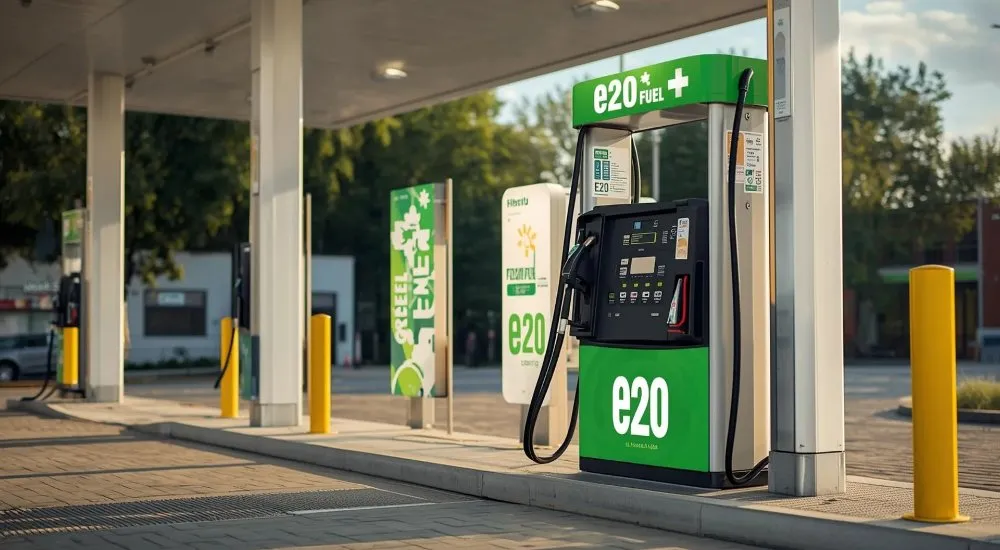
Understanding India’s Biofuel Strategy
India’s biofuel strategy has developed gradually over the past 20 years.
The initial project pursued a blend of 5% ethanol in petrol and subsequently reached a blend of 10% ethanol (E10). All the recent events have resulted in an earlier-than-planned increase in E20 Fuel India.
The officials stated that the rapid development demonstrates that India is prepared to achieve its climate change goals and its domestic biofuel production plans.
The Indian Ministry of Petroleum has stated that all tests have been carried out to ensure that the increased level of ethanol is safe.
At the same time, opponents argue that technologies are developing more slowly than the policy.
E20 fuel principle
Ethanol is a type of fuel based on alcohol that can be mixed with petrol.
When oxygen is present in the composition, the burning process is much cleaner than when it is burnt with petrol.
The key advantages of E20 fuel in India are the following:
- Key points of E20 Fuel India
- Reduction in carbon emissions
- Reduced consumption of fossil fuels
- Sustainability
- High octane rating
- Low power density
The last point is important because ethanol has less energy than petrol.
Impacts of E20 Fuel in India
Decrease in Oil Imports
India spends a lot of money on crude oil imports.
The implementation of blending ethanol with petrol helps reduce reliance on foreign energy sources.
A decrease in imports leads to a boost in India’s economy and energy independence.
A Cleaner Environment
One reason for promoting sustainable energy in India is to reduce harmful emissions.
Compared to traditional petrol, processing ethanol is expected to provide:
- Less carbon monoxide emissions
- Less particulate matter pollution
- Less greenhouse gases emissions
- All these features match India’s climate promises.
Assistance for Farmers
The introduction of biofuels into petrol creates many opportunities for crops such as sugar cane and maize.
Farmers benefit as a result of:
- High demand for crops
- Stable prices for agricultural goods
- Income opportunities
This became one of the main arguments in support of ethanol blending.
Better Energy Security
Global conflicts can constantly interfere with oil markets.
Producing ethanol domestically allows India to avoid exposure to oil price volatility.
The recent upheaval in oil markets has prompted the government to consider introducing E20 Fuel India.
- Better Octane
The octane rating of the fuel is increased by ethanol.
Higher-octane fuel improves fuel efficiency in compatible engines and vehicles.
Automobile Industries in India Express Views
Several major players in the automobile sector have expressed their approval of the government initiative.
The Maruti Suzuki E20 team said that exhaustive in-house examinations found no evidence of mechanical failure while the fuel was in use.
Representatives of the automobile industry claim that:
Currently available automobiles are much more suitable for E20 Fuel India use.
Historical data show the reliability of E20.
Most reported issues are not scientifically substantiated.
However, it creates doubts about millions of old cars still on the roads across the country.
Concerns Regarding E20 Petrol are on the Rise all Over India
Despite the government’s stance that E20 petrol in India is perfectly safe for mass use, complaints from users have steadily increased since ethanol-based petrol began being sold at petrol stations.
Many motorists have taken to social media, various online automobile forums, and consumer complaint pages to report their problems, which they link to E20 Fuel India petrol.
Among the most frequently voiced complaints:
- Lower fuel economy
- Increased engine sound
- Slower speed
- More frequent car service
- Gasoline residue
- Engine lights on
- More money is spent on maintenance.
All these cases have provoked discussions about whether it is reasonable to shift quickly to biofuels inE20 Fuel India.
Fuel Efficiency E20: Why Drivers Are Seeing Lower Mileage
One of the primary issues surrounding E20 Fuel India is fuel efficiency.
Unlike conventional petrol, ethanol provides less power per litre of fuel. As such, vehicles tend to cover less distance per unit of fuel.
The automobile industry acknowledges this fact.
Some of the studies conducted within the sector estimate that understanding eco-fuel has led to a decrease in efficiency equal to:
- 3%
- 4%
- Up to 10% in the case of some older machines
The efficiency does depend on particular aspects such as:
- Machine structure
- Car age
- Driver behaviour
- Road quality
- Quality of maintenance
For Indians, who often pay close attention to efficiency, any decrease in efficiency would cause a mess.
Some believe that if efficiency decreases, one must pay less for fuel, yet the price remains unchanged in most places.
Engine Wear E20: Should I Be Worried?
Another significant problem with E20 fuel in India is whether it causes engine wear E20 Fuel India.
Some mechanics have noticed a need for extra servicing on older vehicles.
Examples of this situation include the following:
- Fuel injection clogging
- Fuel pump reliability
- decreasesRubber seals deterioration
- Water accumulation
- Corrosion of the fuel system
Experts state that the presence of ethanol increases the H2O content in the fuel drain
Moisture will lead to rust formation, which will damage the interiors of tanks and distribution systems. This states that moisture will affect vehicles not using specific additives when ethanol blends exceed conventional quality standards.
Despite the above, the engineers acknowledge that no significant research on the use of E20 Fuel India has been conducted, proving that it does not cause any severe problems in vehicles.
To illustrate their point, the engineers state that:
- Proper vehicle care will reduce the risk faced.
- Modern-day vehicles can use ethanol without a hassle.
- Older vehicles need more upkeep.
The engineers are left with many doubts due to the lack of research.
Maruti Suzuki supports the E20 fuel issue
Maruti Suzuki is one of the biggest proponents of the fuel policy in E20 Fuel India.
The company’s members have said, in response to questions, that enough studies have been conducted showing no negative effects of E20 Fuel India on vehicles.
The members of the company claim that:
- Many vehicles have undergone maintenance.
- Very few fuel problems have occurred.
- New vehicles can often rely on this fuel.
- Engineering studies back this statement.
Delhi E20 Protest Highlights Public Frustration
Public discontent surged as motorists participated in the Delhi E20 Fuel India protest.
Motorists blamed policymakers for not providing consumers with enough options for using E20 fuel in India.
Stated issues were:
- Older vehicles are not compatible with this fuel.
- Gas stations hardly advertise unblended gasoline.
- Consumers pay the same price despite more mileage.
- Service fees increase.
The supporters of the protest argued that it was not right to use E20 Fuel India until older cars gradually died out.
This protest has renewed the discussion about environmental policies and the principles that should be considered to address affordability issues for customers.
The government also dismissed much of the information shared by users online, calling it misinformation, but admitted that educating the public should continue.
Why has India been making progress in expanding renewable fuel
The government is determined to expand renewable E20 Fuel India despite the criticism.
- The government has various reasons to do so.
- Decrease Imports
- India imports a large amount of crude oil.
The decrease in dependence on oil will:
- Help improve energy security.
- Help save money on the foreign exchange market.
- Help reduce the vulnerability to any global crises.
- Keep Being Responsible for Farmers
The large production of ethanol leads to an increase in the need for:
- Sugarcane
- Grain
- Agro-biomass
- This increases income among the rural population.
- Cutting emissions
- Sustainability is the main priority.
Compared with ordinary gasoline, burning ethanol produces fewer greenhouse gases.
Producing fuels at home decreases dependence on unpredictable global energy markets.
This has become increasingly relevant after international geopolitical issues disrupted oil supplies.
The Oil Import Challenge for India
One of the strongest points in favour of India’s biofuels replacing gasoline is that it reduces India’s dependence on oil imports.
Every year, India spends billions of dollars purchasing crude oil from around the world.
Global conflicts lead to:
- oil price spikes
- shipping delays
- pressure on currency
- inflation
Expanding ethanol production provides an alternative transport fuel that comes entirely from E20 Fuel India.
According to government economists, greater energy production at home means greater economic resilience for the nation.
What do Experts Say About E20 Fuel in India?
Industry experts are divided in their opinions.
Proponents present the following arguments in support of ethanol:
- lower emission of gases
- greater energy independence
- sustainability
- increased income of farmers
Opponents point out:
- inferior E20 Fuel India efficiency
- more frequent service
- compatibility issues with older cars
- little independent scientific evidence
Many scientists suggest a gradual shift, similar to that of Brazil’s successful ethanol program, which allowed consumers decades to adjust rather than a few years.
Future of E20 Fuel India: What Lies Ahead?
The E20 fuel rollout in India signifies an important step towards cleaner transport and greater energy independence. The transition has stirred debates, but experts argue that ethanol blending will remain one of the pillars of E20 Fuel India fuel policy for years to come.
India’s government has launched an initiative to promote the use of renewable energy across all sectors, including but not limited to transport and agriculture. Innovations in vehicle technology will help ensure that future petrol engines operate on higher ethanol blends without many issues.
Car manufacturers have begun modifying their engines to run effectively on petrol blended with ethanol in India.
Experts predict that in ten years:
- Most of the newly manufactured petrol cars will run on E20 fuel.
- The capacity for biofuel production will increase.
- Demand for biofuel crops will grow for farmers.
- India will lower its dependency on imported oil.
- Cleaner transport technologies will become cheaper.
Is E20 Fuel India safe for older automobiles?
One of the main questions regarding E20 Fuel India concerns its use in older automobiles.
The solution largely depends on the automobile’s design and age.
- The majority of vehicles produced before the recent emission regulations were constructed to run on E10.
- Older engines will experience:
- Lower efficiency of fuel E20
- Deterioration of fuel hoses
- Excessive maintenance of the vehicle
- Fuel injector clogging
Potential wear and tear of engines from the use of E20 Fuel India for long periods of time.
Nonetheless, experts point out that big failures of the unit are quite rare
To minimise potential risks, older automobile drivers need to do the following:
Respect the manufacturer’s maintenance requirements.
- Replace decayed rubber fuel parts.
- Clean fuel injectors.
- Use quality engine oil.
- Follow fuel consumption rates.
If you have doubts about the compatibility of cars with E20 fuel, check with the manufacturer or an authorised service centre about any potential negative impacts.
The government’s response to public anxieties
In the wake of complaints about the use of E20, Indian government authorities have repeatedly defended the introduction of this fuel.
According to government officials:
- They say extensive testing has been carried out, confirming the fuel’s safety.
- Modern automobiles work just fine with E20.
- The environmental benefits of using E20 fuel in India outweigh the short-term problems this fuel causes.
- Along with that, the officials launched a campaign to educate consumers.
The authorities have characterised many viral claims on social media as incorrect or misleading, while urging drivers to follow the government’s instructions and the advice from the companies they purchase cars from.
How good is E20 ethanol for India?
E20 is making a good impact on E20 Fuel India economy.
- Helping farmers
The increase in the need for ethanol creates stable markets for:
- growers of sugarcane
- maize cultivators
- Cooperatives in agriculture
Not only does it improve and diversify farmers’ incomes, but it also facilitates the development of agriculture in India.
- Spending less on foreign currencies
Fewer oil imports in India will lead to less pressure on foreign reserves.
Each litre of ethanol produced in E20 Fuel India will replace imported fuel, allowing the country to retain more of its currency.
- Encouraging investments
The growth in the production of ethanol brings on investments in:
- biofuels
- agricultural processing
- green energy sector
- rural jobs
The main thing about E20 Fuel India Use of fuels in India
Environmental sustainability in India is the strongest point in support of biofuels.
Ethanol is better than gas since:
- It reduces greenhouse gas emissions.
- It allows the use of less carbon monoxide.
Although producing ethanol requires natural resources, it is believed that producing renewable energy is still more beneficial than using fossil fuel imports.
E20 is a good way to reduce carbon emissions.
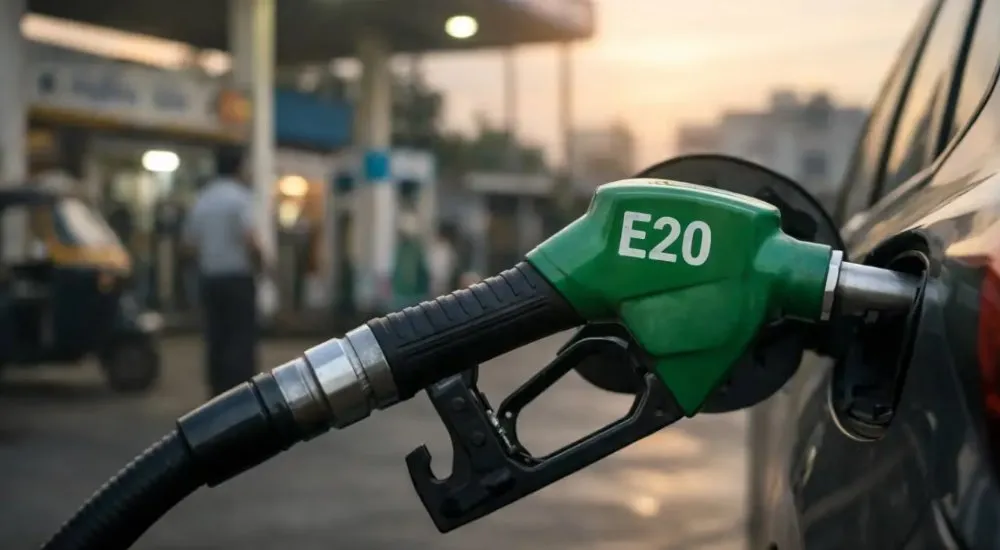
Problems That Need Resolution: A paragraph rewrite
Despite the great progress made towards making E20 fuel acceptable to the public in India, some problems remain to be solved.
Compatibility of Vehicle Types
There are millions of old cars still in use in India, and their complete replacement will take many years.
Public Awareness
Currently, a great number of drivers do not know:
- Which cars can run E20?
- What is the effect of ethanol on mileage?
- What is recommended regarding maintenance?
Price of the Fuel
Consumers believe that fuel prices should be lower due to the low fuel efficiency of E20.
Independent Research
There are calls for independent long-term studies of the following areas:
Durability of the engine.
Maintenance cost of E20 fuel vehicles
- Environmental impact.
- User feedback.
- Experts’ opinion
The majority of automobile experts share the following ideas:
- Ethanol is good for the environment.
- There will be a decrease in mileage.
- Modern engines can use E20.
- Older cars need special care.
- If managed properly, risks can be avoided.
Thus, rather than opposing ethanol fuel, many professionals suggest that public education be improved and that modern designs supporting E20 Fuel India be introduced.
Conclusion
E20 fuel in India is one of the most significant developments in transportation in recent times.
The objectives are quite simple:
- Less dependence on foreign oil
- More energy security
- Reduced emissions
- Assistance to Indian farmers
- Creating a sustainable transportation system
At the same time, public concerns about E20 Fuel India efficiency, engine wear, and vehicle servicing costs show that the key to a successful environmental policy is striking a balance between environmental objectives and consumer trust.
Before long, many of these problems might disappear as new E20-compatible cars roll out.
For the moment, drivers should stay informed, follow manufacturers’ recommendations, and take care of their vehicles.
At TopTrendingHub, we will continue to keep you updated on everything happening with E20 Fuel India, renewables, automotive innovations, and government policies in transportation.
Commonly Asked Questions (FAQs)
- What is E20 fuel in India?
E20 fuel in India is a mixture of 20% ethanol and 80% petrol, which will help reduce oil imports and carbon emissions.
- Is E20 petrol safe for old automobiles?
Usually, modern cars are designed for E20 Fuel India, while older automobiles may experience reduced fuel economy or require additional maintenance. Thus, car owners should consult their manufacturer.
- Why has the government introduced E20 fuel in India?
The government has introduced E20 fuel to promote energy independence by reducing crude oil imports, lowering emissions, and growing local ethanol production.
- Is E20 fuel harmful for fuel efficiency?
Indeed Since ethanol has less energy content than petrol, numerous vehicles experience a slight decrease in fuel efficiency whenever E20 fuel is used.
- Does E20 fuel harm car engines?
At present, no proof of any major problems with car engines has been found. However, older cars that were not designed with E20 in mind may require maintenance due to issues with older versions.
- What are the advantages of biofuels in India for petrol?
Among the many advantages of biofuels in E20 Fuel India are reduced crude oil imports, reduced emissions, increased farmers’ income, improved energy independence, and support for renewable fuel production.
- What is the future of E20 Fuel India?
The plan is to increase ethanol production even more, convince automobile producers to design cars compatible with E20, develop renewable fuel production, and reduce petroleum imports.